
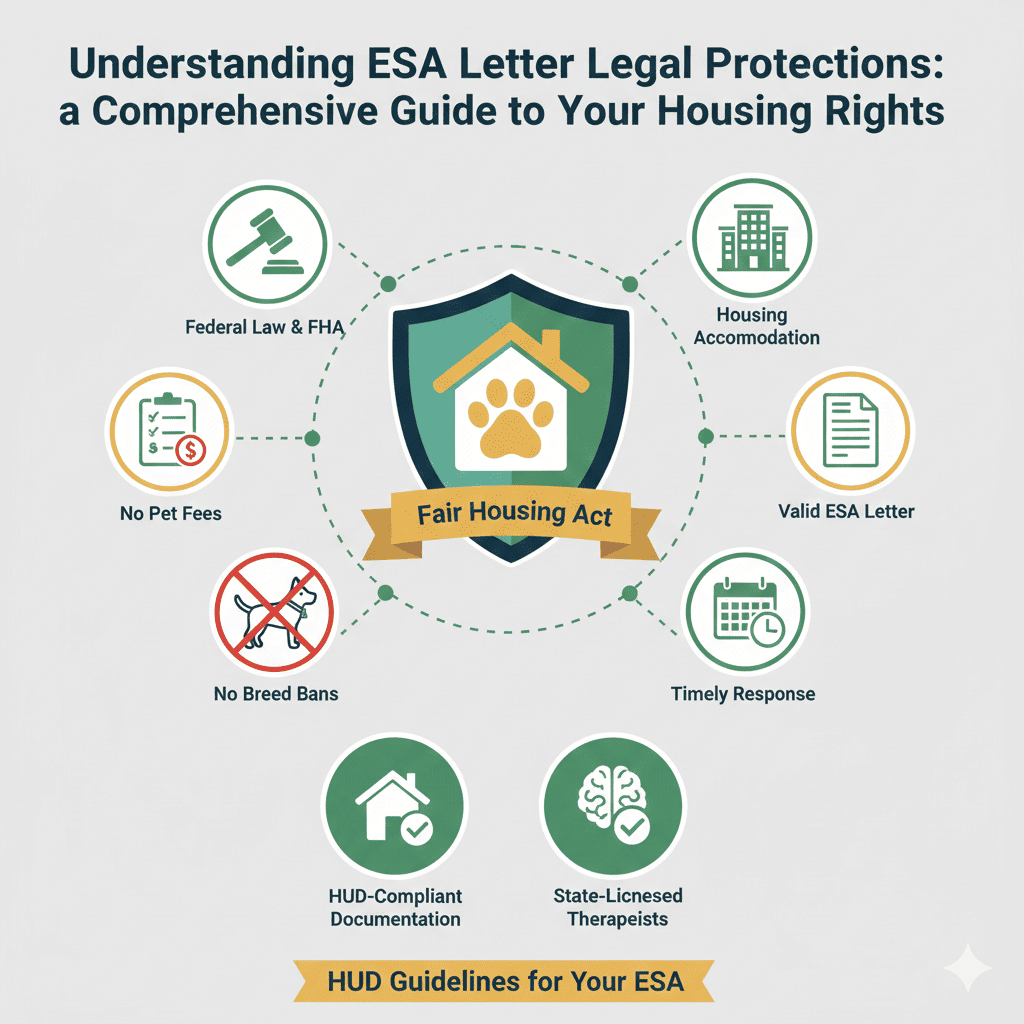
Understanding ESA Letter Legal Protections: A Comprehensive Guide to Your Housing Rights
Understanding ESA Letter Legal Protections: A Comprehensive Guide to Your Housing Rights
For many people, the bond with an animal is more than just friendship—it is a cornerstone of mental and emotional health. Whether you are managing anxiety, depression, or PTSD, your emotional support animal (ESA) provides the consistency and comfort needed to navigate life’s challenges. However, the fear of housing discrimination or expensive pet fees often prevents people from seeking the support they deserve.
The good news is that federal law provides robust ESA letter legal protections. When you have a valid ESA letter, your animal is no longer viewed as a “pet” in the eyes of the law; it is an assistance animal. This guide will help you understand exactly how these protections work, what your landlord is required to do, and how you can ensure your rights are fully upheld.
The Foundation of ESA Letter Legal Protections: The Fair Housing Act (FHA)
The primary source of ESA letter legal protections is the Fair Housing Act (FHA). Managed by the U.S. Department of Housing and Urban Development (HUD), the FHA was designed to ensure that individuals with disabilities—both physical and mental—have an equal opportunity to use and enjoy their dwellings.
Key Provisions Under the FHA:
-
Mandatory Reasonable Accommodation: Landlords must make “reasonable accommodations” for tenants with disabilities. Allowing an ESA in a building with a “no-pets” policy is considered a standard reasonable accommodation.
-
Definition of Assistance Animal: Legally, an ESA is categorized as an assistance animal, not a pet. This distinction is the source of all your financial and policy-based exemptions.
-
No Discrimination: A housing provider cannot refuse to rent to you, evict you, or offer different lease terms simply because you require an emotional support animal.
What the Law Guarantees You
When you present a legitimate ESA letter, you unlock specific legal safeguards that protect your finances and your living situation.
1. Exemption from “No-Pet” Policies
Even if your lease states “No Pets Allowed,” your ESA is legally permitted to live with you. Federal law overrides these private building rules to ensure you have access to your therapeutic support.
2. Waiver of Pet Deposits and Monthly Pet Rent
One of the most valuable ESA letter legal protections is financial. Since the animal is not a pet, the landlord cannot charge:
-
Upfront pet deposits (even if they are refundable).
-
Monthly pet rent.
-
One-time pet move-in fees.
3. Immunity from Breed and Weight Restrictions
Many apartments have “restricted breed” lists or weight limits (e.g., no dogs over 50 lbs). Under the FHA, these blanket rules do not apply to ESAs. A landlord can only deny a specific animal if they can prove it poses a direct threat to the safety of others—not based on its breed or size.
The Components of a Legally Compliant ESA Letter
To trigger these ESA letter legal protections, your documentation must meet the strict standards set by HUD. A simple “registration” or a vest bought online is not enough.
A valid letter must include:
-
Licensed Professional’s Credentials: It must be written by a Licensed Mental Health Professional (LMHP) such as a psychiatrist, psychologist, or LCSW.
-
State Licensure: The professional must be licensed to practice in your state.
-
The Nexus: The letter must state that you have a disability and that the animal provides support that alleviates at least one symptom of that disability.
-
Provider Contact Info: Landlords have the right to verify that the letter is authentic and the license is active.
| Document Type | Provides Legal Protection? | HUD Recognized? |
| ESA Letter from LMHP | YES | Yes |
| Online “Registry” Certificate | NO | No |
| Official ID Badge/Vest | NO | No |
| Letter from a Physician | YES | Yes |
At Perfect ESA Letter, we ensure your letter meets every one of these requirements, so your rights are never in question.
State-Specific Enhancements to Federal Law
While the FHA is federal, many states have passed their own laws to reinforce ESA letter legal protections and prevent fraud.
-
California: Requires a 30-day established relationship with a clinician before an ESA letter can be issued.
-
Florida & Texas: Have specific statutes that make misrepresenting an animal as an ESA a punishable offense, which actually helps legitimate ESA owners by reducing skepticism from landlords.
-
Montana: Also mandates a 30-day therapeutic relationship with the provider.
Our network of clinicians at Perfect ESA Letter stays up-to-date on these shifting state requirements to ensure your letter is compliant in your specific location.
What Landlords CAN and CANNOT Legally Do
Knowing the boundaries of a landlord’s power is essential for protecting your medical privacy.
Landlords CAN:
-
Ask for a valid ESA letter if your disability is not obvious.
-
Verify the clinician’s license number in the state database.
-
Ask the clinician to confirm they wrote the letter.
-
Charge you for actual damages caused by the animal (deducted from your regular security deposit).
Landlords CANNOT:
-
Ask for your medical records: They have no right to see your diagnosis or treatment history.
-
Demand a specific form: They must accept a valid letter and cannot force your doctor to fill out their proprietary paperwork.
-
Require the animal to be “trained”: Unlike service dogs, ESAs do not need specialized training to be legally protected.
-
Charge a fee for processing the request: The accommodation process must be free of charge.
Internal Linking Suggestions
-
Anchor Text: how to qualify for an ESA (Link to eligibility/conditions page)
-
Anchor Text: ESA vs. Service Dog guide (Link to comparison article)
-
Anchor Text: state-specific ESA laws (Link to a legal resources page)
Frequently Asked Questions (FAQs)
1. Can a landlord deny my ESA because of its breed?
No. Under ESA letter legal protections, breed restrictions do not apply. A landlord can only deny an animal if that specific animal has a history of aggression or dangerous behavior.
2. Do I have to tell my landlord I have an ESA before I sign the lease?
No. You are not legally required to disclose your ESA during the application process. Many tenants wait until the lease is signed to submit their request to avoid “stealth discrimination.”
3. Does an ESA letter work for air travel?
No. While ESAs used to be protected on flights, the laws changed recently. Only Psychiatric Service Dogs (PSDs) are now protected on airplanes. ESA protections are now primarily limited to housing.
4. Can a landlord evict me for having an ESA?
Not if you have a valid ESA letter. If you have the proper documentation and the animal is not causing a nuisance or safety threat, evicting you because of the animal is a violation of the Fair Housing Act.
5. What if I want to have two emotional support animals?
You can have multiple ESAs, but your ESA letter must justify the need for each one (e.g., one dog for anxiety and one cat for depression).
6. Do I need to buy a vest or ID card for my ESA?
No. Vests and ID cards have zero legal standing. The only document that provides ESA letter legal protections is the signed letter from your licensed professional.
7. How long does a landlord have to respond to my request?
HUD guidelines state that landlords should respond to a “Reasonable Accommodation” request promptly, generally within 10 days.
8. What should I do if my landlord denies my valid letter?
If a landlord refuses to accept a valid letter, you can file a formal complaint with HUD or your state’s fair housing agency. Usually, letting the landlord know you intend to do this is enough to resolve the issue.
Secure Your Peace of Mind and Your Housing
Navigating ESA letter legal protections shouldn’t be a source of stress. These laws were created to ensure that your home remains a place of healing and support, not a place of conflict over pet policies. By following the legal path and obtaining a legitimate, clinician-signed letter, you protect your rights, your finances, and your relationship with your animal companion.
At Perfect ESA Letter, we specialize in making this process simple, legal, and fast. We connect you with the right professionals so you can move forward with confidence, knowing that your housing is secure.