
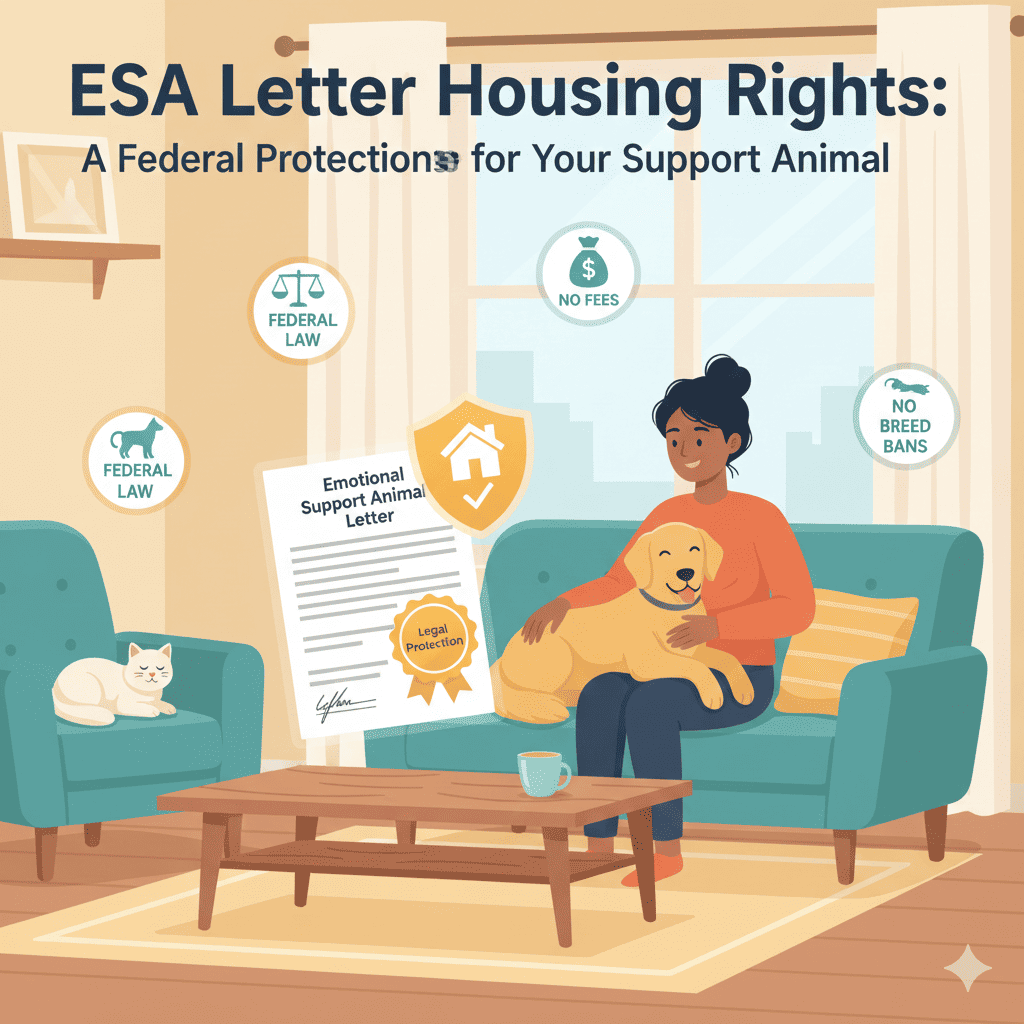
Understanding Your ESA Letter Housing Rights: A Complete Guide to Federal Protections
Understanding Your ESA Letter Housing Rights: A Complete Guide to Federal Protections
Finding a safe, comfortable home is a fundamental need, but for individuals living with mental health conditions, that search often comes with an added layer of stress: the fear of being separated from an emotional support animal (ESA). Understanding your ESA letter housing rights is the most powerful tool you have to ensure that your animal companion is accepted in any residential setting, regardless of “no-pet” policies or restrictive breed bans.
Under federal law, an emotional support animal is not a pet; it is a vital part of a treatment plan for conditions such as anxiety, depression, PTSD, and social phobia. Because of this distinction, you are afforded specific legal protections that prevent landlords from discriminating against you. In this comprehensive guide, we will break down the laws that protect you, the documents you need, and how to handle any landlord pushback with confidence.
The Foundation of ESA Letter Housing Rights: The Fair Housing Act (FHA)
The primary law governing ESA letter housing rights is the Fair Housing Act (FHA). Managed by the Department of Housing and Urban Development (HUD), the FHA prohibits discrimination in housing against individuals with physical or mental disabilities.
Under the FHA, housing providers are required to make “reasonable accommodations” for persons with disabilities. Allowing an emotional support animal to live in a dwelling that otherwise prohibits animals is considered a standard reasonable accommodation.
Key Protections Under the FHA:
-
Exemption from “No-Pet” Policies: Even if a building has a strict no-animals rule, your ESA is legally allowed to reside with you.
-
Waiver of Pet Fees and Deposits: Landlords cannot charge you “pet rent” or demand an upfront pet deposit for an ESA.
-
Bypass of Breed and Weight Restrictions: Traditional rules banning specific breeds (like Pit Bulls or Huskies) or weight limits do not apply to emotional support animals.
-
Access to All Housing Types: This includes private rentals, apartments, condos, and even university dorms.
What Qualifies as a Legitimate ESA Letter?
To exercise your ESA letter housing rights, you must provide your landlord with a valid recommendation from a Licensed Mental Health Professional (LMHP). A simple “certificate” or an “ID card” from a registry website will not suffice and is likely to be rejected.
Essential Components of a Valid Letter:
-
Professional Letterhead: Must include the clinician’s contact information and practice details.
-
License Information: The practitioner’s license type (e.g., LCSW, LMHC, Psychologist), license number, and the state in which they are licensed.
-
The Clinical Connection: A statement confirming that you have a mental or emotional disability and that the animal provides support that alleviates at least one symptom of that disability.
-
The Date: The letter should be current to ensure it reflects your ongoing need for support.
Perfect ESA Letter specializes in connecting tenants with state-licensed professionals who understand these specific HUD requirements, ensuring your documentation is unshakeable.
Common Landlord Objections and How to Resolve Them
Even with a clear understanding of ESA letter housing rights, you may encounter a landlord who is unaware of the law or hesitant to comply. Knowledge is your best defense.
Objection 1: “We have a weight limit of 25 lbs.”
The Legal Reality: HUD guidelines state that breed, size, and weight limitations do not apply to assistance animals. As long as the animal does not pose a direct threat to the safety of others or cause substantial physical damage to the property, the landlord must accommodate them.
Objection 2: “You need to pay a $300 pet deposit.”
The Legal Reality: Since an ESA is an assistance animal and not a pet, charging a pet deposit is a violation of the FHA. However, you are still responsible for any actual damage the animal causes to the unit, which can be deducted from your standard security deposit upon move-out.
Objection 3: “I need to see your medical records.”
The Legal Reality: This is a major boundary. Landlords cannot ask for your specific diagnosis, access to your medical records, or a detailed history of your disability. They are only entitled to the information provided in your ESA letter.
Comparing ESA Rights vs. Service Dog Rights
It is important to know where your ESA letter housing rights begin and end, especially compared to Service Animals protected under the Americans with Disabilities Act (ADA).
| Feature | Emotional Support Animal (ESA) | Service Animal (Dog/Mini Horse) |
| Primary Law | Fair Housing Act (FHA) | Americans with Disabilities Act (ADA) |
| Housing Protection | Full Protection | Full Protection |
| Public Access (Stores/Malls) | No Legal Right | Full Access Rights |
| Air Travel | Subject to Airline Policy | Required to Fly in Cabin |
| Training Required | No Special Training | Must be task-trained |
How to Properly Request an Accommodation
To ensure your ESA letter housing rights are respected, follow a professional and documented process:
-
Obtain Your Letter First: Never bring an animal into a “no-pet” home without having your letter in hand.
-
Submit a Written Request: While you can ask verbally, a written “Request for Reasonable Accommodation” creates a paper trail.
-
Provide the Letter: Attach your signed clinical letter to your request.
-
Give Reasonable Time: Landlords generally have 10 business days to respond to your request.
Internal Linking Suggestions
-
Anchor Text: qualifying conditions for an ESA (Link to a page on anxiety/PTSD/depression)
-
Anchor Text: ESA laws by state (Link to state-specific legal guides)
-
Anchor Text: how to spot an ESA scam (Link to a guide on avoiding fake registries)
Frequently Asked Questions (FAQs)
1. Can a landlord deny my ESA if they live in the building?
The FHA has a small exemption called the “Mrs. Murphy Exemption.” It applies to owner-occupied buildings with no more than four units. In these specific, small-scale cases, the landlord may be exempt from FHA requirements.
2. Do I need to disclose my ESA before signing the lease?
You are not legally required to disclose your ESA during the application process to avoid potential “stealth” discrimination. However, you must present your letter and get approval before moving the animal in.
3. Can a landlord charge “Pet Rent” for an ESA?
No. Under ESA letter housing rights, pet rent is considered a discriminatory fee. If you have already been paying pet rent and then provide a valid letter, the landlord must stop charging that fee immediately.
4. What if my ESA is a “restricted breed” like a Pit Bull?
The FHA does not allow for blanket breed bans. A landlord can only exclude a specific animal if it has a documented history of aggression or if their insurance company provides proof that the specific animal’s presence would cancel their policy.
5. Does my ESA letter need to be from a doctor in my state?
HUD guidelines prefer that the provider is one who has provided services in your state. Using a service that matches you with a state-licensed LMHP is the best way to ensure compliance.
6. Can my landlord require me to use their specific ESA form?
A landlord can provide a form, but they cannot require it if your ESA letter already contains all the legally necessary information. If their form asks for illegal information (like your diagnosis), you have the right to decline.
7. Can I have more than one ESA in my home?
Yes, you can have multiple ESAs. However, your clinical letter must explain the specific therapeutic need for each animal.
8. What should I do if my landlord denies my request?
If you have a legitimate letter and are denied, you can file a formal complaint with HUD or your local fair housing agency. Many tenants find that simply mentioning their intent to contact HUD resolves the issue quickly.
Claim Your Rights with Confidence
Your emotional support animal is a partner in your mental health journey, and the law recognizes that. You don’t have to choose between your health and your home. By securing a legitimate, clinician-signed document, you are activating a suite of federal protections that keep you and your animal together, safely and affordably.
At Perfect ESA Letter, we specialize in helping tenants exercise their ESA letter housing rights with zero stress. We connect you with compassionate, state-licensed professionals who provide the HUD-compliant documentation you need to protect your peace of mind.
Generate Art for This Post
![A bright, airy apartment interior where a person is sitting comfortably on a sofa, petting their medium-sized dog. On the coffee table, a document with a professional seal is clearly visible. The sunlight is streaming through the window, emphasizing a sense of security, legal protection, and a happy home life.]