
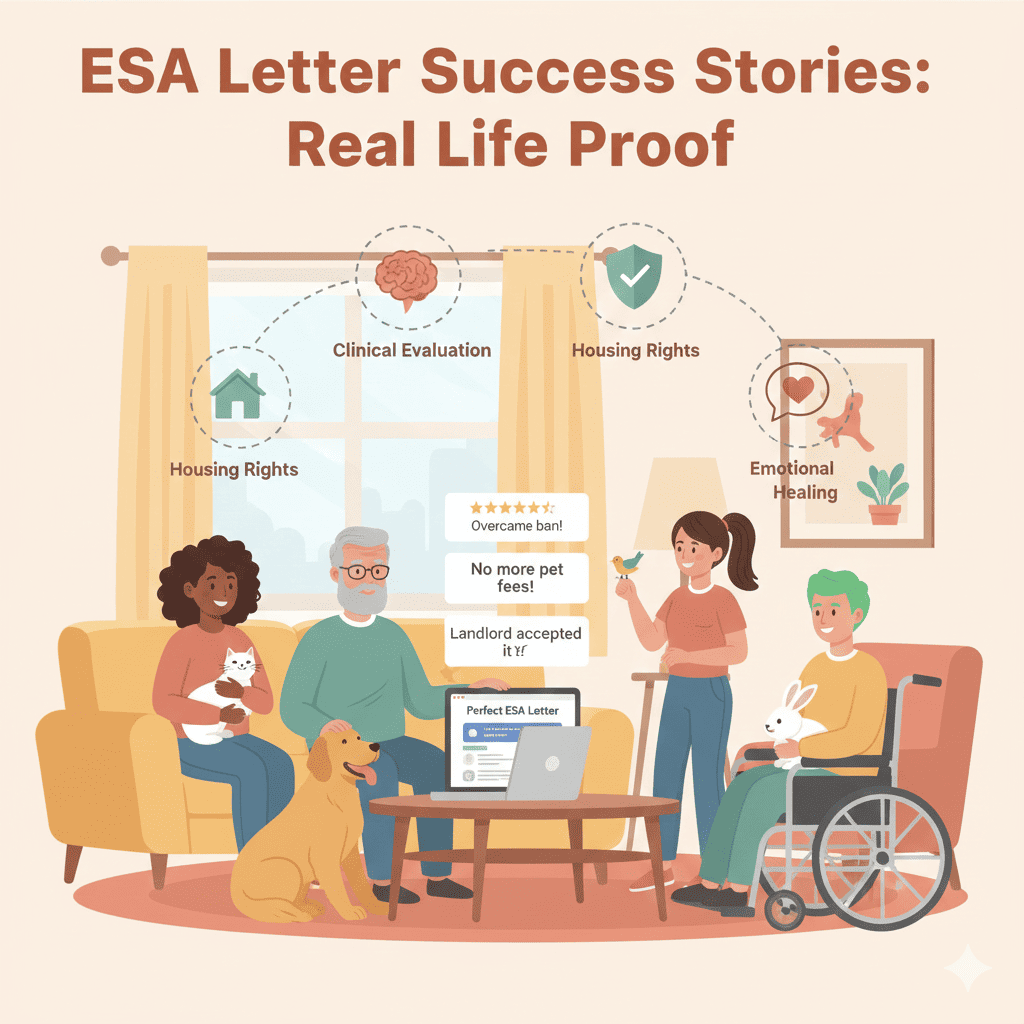
ESA Letter Success Stories: Real Life Proof of Housing Rights and Emotional Healing
ESA Letter Success Stories: Real Life Proof of Housing Rights and Emotional Healing
Finding a home that welcomes your emotional support animal (ESA) shouldn’t feel like an uphill battle. For millions of Americans living with anxiety, depression, or PTSD, an animal isn’t just a pet—it is a vital part of a mental health treatment plan. Yet, “no-pet” policies and expensive pet rents often stand in the way of peace and stability.
This is where ESA letter success stories come in. These stories aren’t just anecdotes; they are proof that the Fair Housing Act (FHA) works when you have the right documentation. From overcoming breed restrictions to saving thousands in pet fees, these real-life accounts show the transformative power of a legitimate ESA letter.
What Makes an ESA Letter Success Story Possible?
A success story begins with a legitimate document. Under federal law, an ESA letter must be issued by a Licensed Mental Health Professional (LMHP). This letter confirms that you have a qualifying mental health condition and that your animal provides specific relief for your symptoms.
When you have a valid letter from a provider like Perfect ESA Letter, you unlock three major legal protections:
-
The Right to Live in “No-Pet” Housing: Landlords must make a reasonable accommodation for your animal.
-
Exemption from Pet Fees: You cannot be charged pet rent, one-time pet fees, or security deposits for your ESA.
-
Exemption from Breed/Size Restrictions: Your animal cannot be denied based on its breed (e.g., Pit Bulls or German Shepherds) or its weight.
Real Life ESA Letter Success Stories
Sarah’s Story: Overcoming the “No-Pets” Policy
Sarah moved to a new city for a high-stress job and found the perfect apartment, but it had a strict “no-pets” rule. Sarah struggled with severe generalized anxiety and relied on her cat, Luna, for grounding.
After using a legitimate telehealth service to connect with a licensed therapist, Sarah received her ESA letter for housing. She presented it to her landlord before signing the lease. Because the letter was HUD-compliant and signed by a state-licensed professional, the landlord legally waived the no-pet policy. Sarah and Luna moved in without a single extra fee.
Marcus’s Story: Saving Thousands in Pet Rent
Marcus lived in a “pet-friendly” complex, but he was paying $75 a month in pet rent for his dog, Max, on top of a $400 initial pet deposit. Marcus, a veteran living with PTSD, didn’t realize that Max qualified as an ESA.
Once he obtained his official ESA letter, Marcus submitted it to his property manager. Not only did the complex stop charging him the monthly $75 fee, but they also refunded his initial $400 deposit. Over a two-year lease, Marcus saved $2,200—money he was able to put toward Max’s veterinary care and high-quality food.
Elena’s Story: Beating Breed Restrictions
Elena owned a sweet, well-behaved Rottweiler named Bear. When she had to move, she was rejected by five different apartments because Rottweilers were on their “aggressive breed” list. Elena suffered from depression and could not imagine life without Bear.
She learned that the Fair Housing Act prevents landlords from banning ESAs based on breed. She obtained her ESA letter and applied for a sixth apartment. When the landlord saw the documentation, they realized they could not legally enforce the breed ban for a support animal. Elena and Bear finally found a safe home together.
Comparison: Legitimate Success vs. Scam Failures
Not every story is a success story. Many people fall for “instant” online registries that provide fake certificates. These stories usually end in housing denial and heartbreak.
| Feature | Legitimate Success (Success Story) | Scam Registry (Failure Story) |
| Document Type | Signed Letter from a Licensed Professional | “Official” Certificate or ID Badge |
| Process | Clinical Consultation with an LMHP | Instant download with no talk |
| Landlord Reaction | Accept and waive all pet fees | Reject and demand a “real” letter |
| Legal Standing | Fully protected by the Fair Housing Act | No legal weight in court or with HUD |
The Path to Your Own Success Story
If you want to be the next person sharing ESA letter success stories, the process is straightforward but requires clinical integrity.
Step 1: Pre-Screening Assessment
Complete a brief questionnaire about your mental health needs. This determines if an ESA might be a beneficial part of your treatment plan.
Step 2: Telehealth Consultation
Speak with a licensed mental health professional. This is the most critical step for a success story. The clinician will evaluate your condition and discuss how your animal helps you.
Step 3: Presenting the Letter to Your Landlord
Once you receive your letter, present it to your landlord as a request for “Reasonable Accommodation.” A legitimate service will provide you with the support you need if the landlord has follow-up questions.
Internal Linking Suggestions
-
Anchor Text: how to qualify for an ESA (Link to the Eligibility page)
-
Anchor Text: Fair Housing Act guidelines (Link to a guide on tenant rights)
-
Anchor Text: ESA vs. Service Dog differences (Link to comparison blog)
Frequently Asked Questions (FAQs)
1. Are these ESA letter success stories common?
Yes! Thousands of renters successfully use ESA letters every month to live with their animals. As long as your letter is legitimate and your animal does not pose a direct threat to others, the law is on your side.
2. Can a landlord ask for proof of my disability?
A landlord can ask for documentation that you have a disability and a disability-related need for the animal (which is what the ESA letter provides). However, they cannot ask for your medical records or the specifics of your diagnosis.
3. Does a success story require the animal to be a dog?
Not at all. Success stories involve cats, rabbits, birds, and even lizards. Any common domesticated animal can be an ESA if it provides support for a mental health condition.
4. What if my landlord says their “insurance” doesn’t allow the breed?
Under HUD guidelines, an insurance policy’s breed restrictions are generally not a valid reason to deny an ESA. The landlord must prove that the specific animal poses a danger or that the insurance company would actually cancel the policy.
5. Do success stories involve university dorms?
Yes. The FHA applies to university-owned housing. Many students successfully live with ESAs in dorms by providing a valid letter to their school’s disability services office.
6. Can I have more than one ESA success story?
Yes. If you have two animals that both provide different forms of support, you can have a “multi-pet” success story. The clinician just needs to document the need for both animals.
7. How long does the “success” last?
Once a landlord approves your ESA, it is generally permanent for the duration of your residency. However, it is a best practice to keep your letter updated annually to reflect your ongoing mental health needs.
8. What is the #1 reason an ESA request fails?
The most common cause of failure is using a “fake” letter or registry certificate. Landlords are legally allowed to reject documentation that does not come from a licensed professional who has evaluated the tenant.
Start Your Success Story Today
Your mental health is a priority, and your right to live with your support animal is protected by federal law. Don’t let a “no-pets” sign or expensive fees keep you from the companionship you need. By obtaining a legitimate, clinician-backed letter, you can join the thousands of others who have found housing stability and emotional healing.
At Perfect ESA Letter, we specialize in creating ESA letter success stories. We connect you with compassionate, state-licensed professionals who provide the exact documentation landlords are required to accept.