
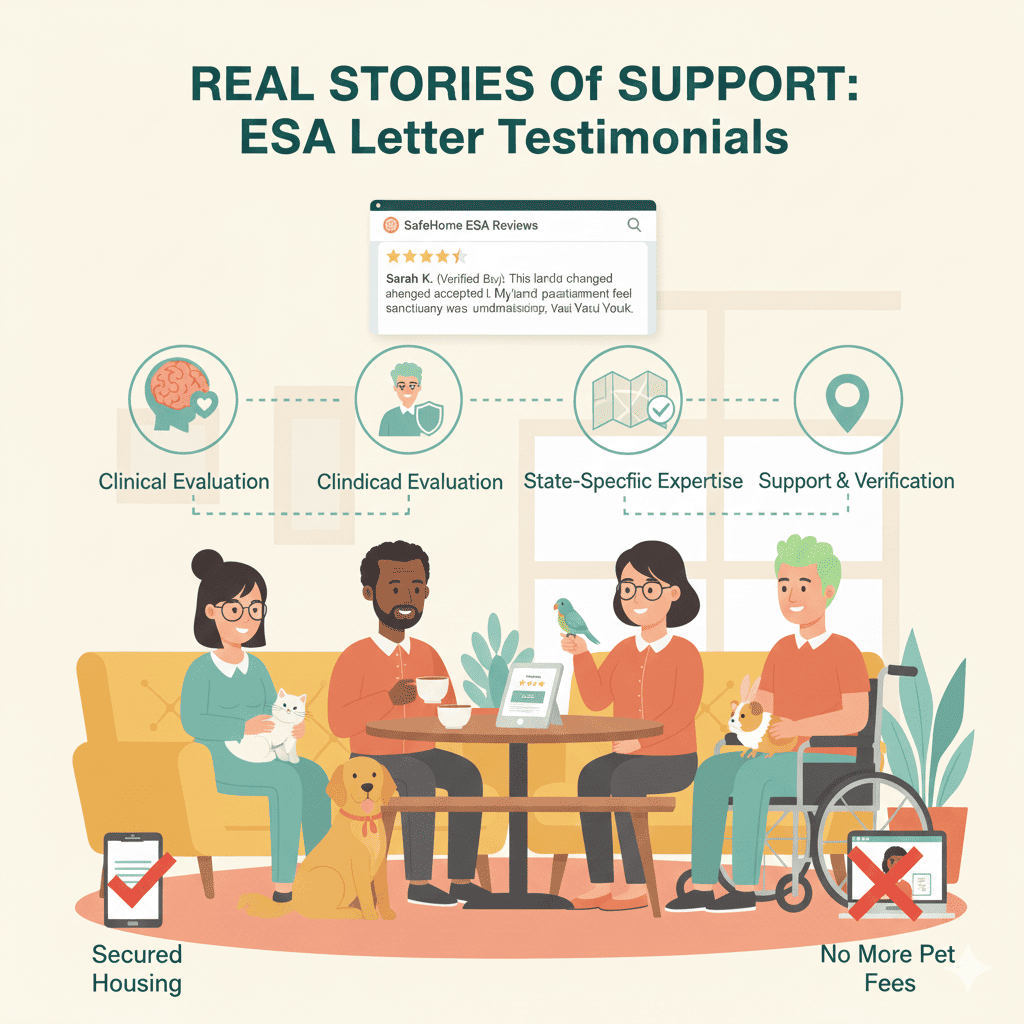
Real Stories of Support: Why ESA Letter Testimonials Matter for Your Housing Journey
Real Stories of Support: Why ESA Letter Testimonials Matter for Your Housing Journey
Living with a mental health disability can feel like an invisible struggle, especially when facing the daunting task of finding pet-friendly housing. For many, an Emotional Support Animal (ESA) is a cornerstone of their mental health treatment, providing the stability and comfort needed to navigate daily life. However, the process of obtaining a legitimate recommendation often leads people to search for ESA letter testimonials to ensure they aren’t falling for a scam.
Authentic testimonials provide more than just social proof; they offer a roadmap for success. They show that with the right documentation from a licensed professional, the Fair Housing Act (FHA) truly works to protect your rights. In this guide, we’ll explore how to evaluate feedback and why real stories are the best indicator of a provider’s legitimacy.
The Power of ESA Letter Testimonials in Choosing a Provider
When you are looking for a service to help you secure your housing rights, the stakes are high. A rejected letter can mean losing your home or being forced to give up your animal companion. This is why ESA letter testimonials are so vital—they highlight the real-world experiences of tenants who have successfully navigated “no-pet” policies.
What to Look for in a Real Testimonial:
-
Specific Challenges: Did the person mention a strict landlord or a complex HOA?
-
The Clinical Process: Does the feedback mention a conversation with a licensed therapist?
-
Outcome: Did the landlord accept the letter without charging pet fees?
-
Support: Was the customer service team helpful when the landlord asked follow-up questions?
By focusing on these details, you can distinguish between a provider that simply sells PDFs and one that offers a comprehensive clinical and legal service.
Legitimate Success vs. “Instant” Scams
The difference between a top-rated service and a “certificate mill” is often visible in the quality of their feedback. Legitimate providers, like Perfect ESA Letter, prioritize clinical integrity over “instant” delivery.
Comparing Feedback Themes
| Feature | Legitimate Service Feedback | Scam Service Feedback |
| Therapist Interaction | “The therapist was kind and listened to my history.” | “I didn’t have to talk to anyone, it was so fast!” |
| Legal Acceptance | “My landlord verified the license and approved my dog.” | “The landlord said the certificate was fake and rejected it.” |
| Compliance | “They matched me with a doctor in my state.” | “The letter came from a doctor in a different state.” |
| Trust Signal | Focuses on housing stability and mental health. | Focuses on “Official Registries” and ID cards. |
Why Landlords Trust Professional ESA Letters
Landlords are increasingly wary of “online certificates.” However, they cannot legally ignore a letter that meets HUD requirements. ESA letter testimonials often mention how a professional, clinician-signed document shifted the conversation with their property manager.
When a letter is written on an LMHP’s official letterhead and includes their license number, it provides the landlord with the legal assurance they need. It proves that the tenant has a disability-related need for the animal, which triggers the mandatory “reasonable accommodation” under the FHA.
Financial Benefits Mentioned in Testimonials:
-
Waived Pet Rent: Saving $300–$1,200 annually.
-
No Security Deposits: Keeping $200–$500 in your pocket.
-
Bypassing Breed Bans: Living with your Pittie, Shepherd, or Husky in restricted buildings.
How to Get Your Own Success Story
If you’re ready to add your voice to the positive ESA letter testimonials, the process is designed to be supportive and stress-free.
1. The Clinical Assessment
The first step is a questionnaire that helps the licensed professional understand your mental health history. This is not a “test,” but a way to ensure the animal truly provides therapeutic relief for your symptoms.
2. The Consultation
You will have a telehealth consultation with a Licensed Mental Health Professional (LMHP) licensed in your state. This is the gold standard for legitimacy. This conversation ensures the letter is rooted in a real provider-patient relationship.
3. Presenting Your Letter
Once you receive your signed document, you present it to your landlord. A reputable service will provide you with a guide on how to communicate your request effectively to ensure a smooth approval process.
Internal Linking Suggestions
-
Anchor Text: “qualifying for an ESA” (Link to the Eligibility page)
-
Anchor Text: “ESA vs Service Animal” (Link to a comparison article)
-
Anchor Text: “Landlord rights and ESAs” (Link to an educational blog)
Frequently Asked Questions (FAQs)
1. Are ESA letter testimonials on a website enough to prove it’s legitimate?
While testimonials are helpful, you should also verify that the site connects you with state-licensed professionals and uses HIPAA-compliant systems. Check third-party review sites for unbiased feedback as well.
2. Can a landlord call the doctor who signed my letter?
Yes. Landlords are permitted to verify the authenticity of the letter and the license of the professional. This is why it is crucial that your letter is signed by a real, licensed clinician.
3. Do testimonials mention if ESAs are allowed in dorms?
Yes, many students share success stories of bringing their ESAs to college. The Fair Housing Act applies to university-owned housing just as it does to private rentals.
4. What if my testimonial is negative because a landlord was difficult?
A difficult landlord doesn’t mean the letter is invalid. If a landlord is violating the FHA, a legitimate service will provide support to help you educate the landlord on federal law or file a complaint with HUD.
5. Why do some testimonials mention a waiting period?
States like California have passed laws requiring a 30-day relationship with a provider before a letter can be issued. Legitimate providers will follow these laws, which is a sign of their authority.
6. Can I get a letter for a cat or a different animal?
Absolutely. Testimonials often feature cats, rabbits, and even birds. The FHA covers all common domesticated animals that provide emotional support.
7. Does the letter need to mention my specific diagnosis?
No. Your privacy is protected. The letter only needs to state that you have a mental health disability and that the animal is a necessary part of your treatment.
8. How long does it take for my story to become a success?
Most individuals who use a professional service receive their documentation within 24 to 48 hours and get landlord approval shortly after submitting their request.
Start Your Success Story Today
You don’t have to navigate the complexities of “no-pet” housing alone. Real ESA letter testimonials prove that the right documentation can change your living situation and improve your quality of life. By choosing a service that prioritizes clinical standards and legal compliance, you are taking the most important step toward protecting your support animal.
At Perfect ESA Letter, we are committed to helping you find the same peace of mind shared by our thousands of successful clients. We connect you with compassionate, licensed professionals who understand your needs and provide documentation that stands up to landlord scrutiny.
Generate Art for This Post
![An image representing housing success and emotional support: A happy individual sitting on a sofa in a modern apartment, hugging a golden retriever. The scene is warm and sunlit, symbolizing the peace and security found in a pet-friendly home. The color palette features soft blues and warm woods to evoke a sense of trust and tranquility.]
Next Step: Would you like me to generate more keywords for your next blog post?