
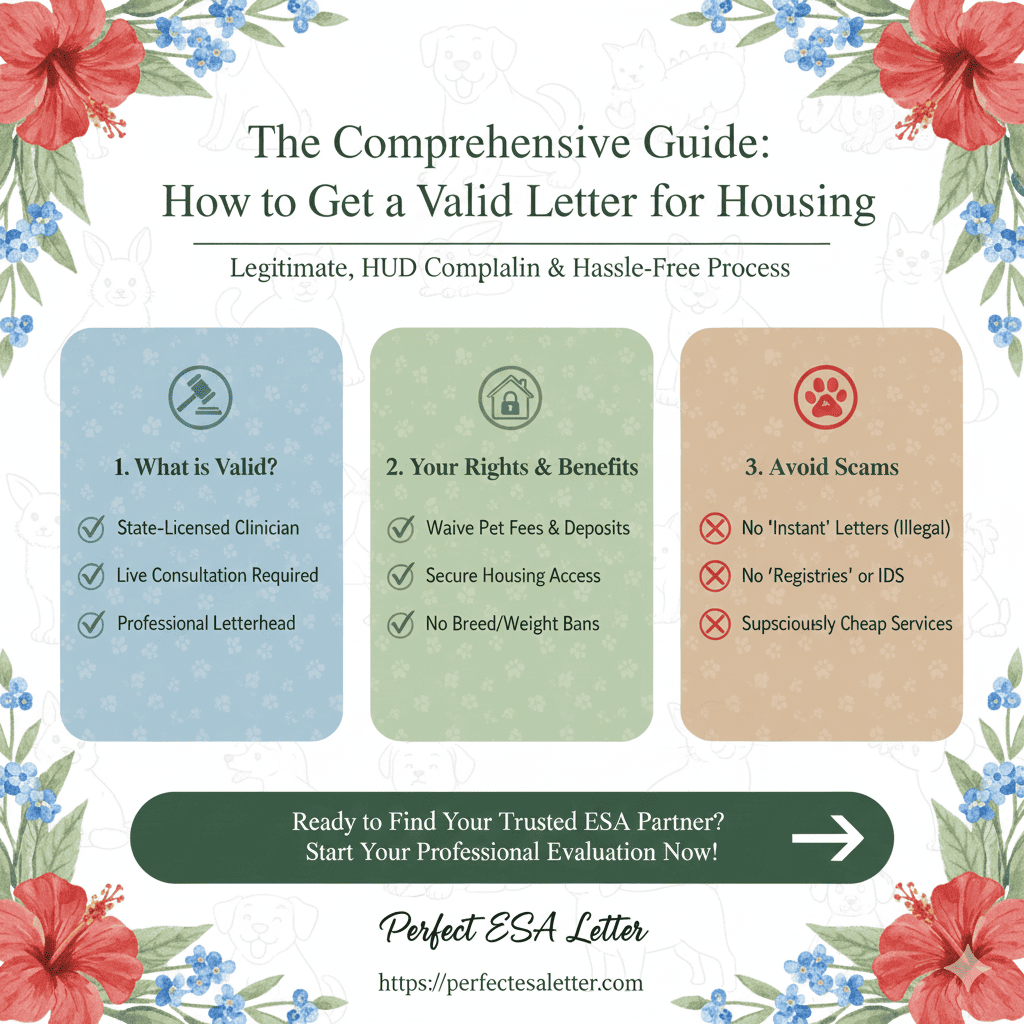
The Comprehensive Guide: How to Get a Valid ESA Letter for Housing
The Comprehensive Guide: How to Get a Valid ESA Letter for Housing
For many individuals, an emotional support animal (ESA) is a fundamental part of a mental health treatment plan. Whether you are dealing with chronic anxiety, PTSD, or depression, the presence of a loyal companion can provide the stability needed to navigate daily life. However, to enjoy the legal protections afforded to these animals—such as living in “no-pet” housing and waiving pet fees—you must know exactly how to get a valid ESA letter.
The rental market is increasingly strict, and property managers are more educated than ever on federal guidelines. A generic “certificate” or “registration” from a random website will likely be rejected, potentially putting your housing at risk. To protect your rights, you need a document that is medically sound and legally ironclad.
At Perfect ESA Letter, we specialize in connecting individuals with state-licensed mental health professionals who provide legitimate, HUD-compliant documentation. Apply for an ESA letter now to begin your journey toward stress-free housing.
What is a Valid ESA Letter?
A valid ESA letter is essentially a prescription for an assistance animal. It is a formal document written by a Licensed Mental Health Professional (LMHP) that confirms your need for an emotional support animal as part of your treatment for a mental or emotional disability.
The Legal Framework: The Fair Housing Act (FHA)
Under the FHA, an emotional support animal is not a pet; it is an “assistance animal.” This classification grants you three major rights:
-
Exemption from “No-Pet” Policies: You can live in properties that otherwise prohibit animals.
-
Exemption from Pet Fees: You cannot be charged pet rent, non-refundable pet fees, or pet deposits.
-
Waiver of Breed/Weight Restrictions: Landlords cannot deny your ESA based on its breed or size.
To trigger these protections, your letter must meet the specific standards set by the U.S. Department of Housing and Urban Development (HUD).
How to Get a Valid ESA Letter: A Step-by-Step Process
Securing a legitimate letter is a clinical process, not a retail transaction. Follow these steps to ensure your documentation stands up to landlord scrutiny.
1. Identify a Licensed Professional
The most critical step in how to get a valid ESA letter is ensuring your provider is qualified. A valid letter must be written by a professional licensed in your state of residence. Qualified professionals include:
-
Psychiatrists and Psychologists
-
Licensed Clinical Social Workers (LCSW)
-
Licensed Professional Counselors (LPC)
-
Licensed Marriage and Family Therapists (LMFT)
-
Mental Health Nurse Practitioners
2. Complete a Clinical Evaluation
You must undergo an assessment where the professional evaluates your mental health. During this consultation, you will discuss how your symptoms (such as panic attacks, insomnia, or social withdrawal) are mitigated by the presence of your animal.
Note: Many states, including California and Montana, now require a 30-day established relationship with a clinician before an ESA letter can be issued. Legitimate services will always adhere to these state-specific cooling-off periods.
3. Receive Your HUD-Compliant Letter
Once approved, your clinician will issue a letter on their official letterhead. A valid letter must contain:
-
The clinician’s full name and professional credentials.
-
Their license type, license number, and the state of issuance.
-
The date the letter was issued.
-
A clear statement that you have a mental or emotional impairment that limits a major life activity.
-
An explanation of how the animal alleviates symptoms of that impairment.
Red Flags: How to Avoid ESA Scams
The internet is flooded with “instant” ESA services. If you are looking for how to get a valid ESA letter, avoid any site that exhibits the following red flags:
-
“Instant” Approval: Legitimate clinical evaluations take time. If you can get a letter in 5 minutes without talking to a human, it is not valid.
-
ESA Registrations/ID Cards: There is no such thing as an official “ESA Registry.” HUD explicitly states that registration papers and ID tags are not sufficient to prove an animal’s status.
-
“Lifetime” Letters: Most landlords require an ESA letter to be dated within the last 12 months. Any service promising a “lifetime” document is ignoring industry standards.
-
Unbelievably Low Prices: A real clinical consultation has a cost. Sites offering letters for $30 are often selling templates that have no legal standing.
Why Choose Perfect ESA Letter for Your Documentation?
When your housing is on the line, you cannot afford to take a shortcut. Perfect ESA Letter is built on a foundation of E-E-A-T (Experience, Expertise, Authoritativeness, and Trustworthiness).
State-Licensed Network
We match you with a provider who is licensed to practice in your specific state. This is vital because a Florida landlord is not required to accept a letter from a therapist licensed only in New York.
Telehealth Convenience
We bring the clinician to you. Our secure, HIPAA-compliant platform allows you to complete your evaluation from the comfort of your home, making it easier for those with social anxiety or mobility issues to get the help they need.
Landlord Verification Support
If your property manager calls to verify the authenticity of the letter, our clinicians are available to confirm that the document is valid and was issued following a legitimate evaluation.
Internal Linking & Resources
Frequently Asked Questions (FAQs)
1. Can a landlord ask for my medical records?
No. Under the Fair Housing Act, a landlord can ask for documentation confirming your disability-related need for the animal, but they cannot ask for your specific diagnosis, medical history, or a list of your medications.
2. Do I need to get my animal a vest or a tag?
No. While vests can be helpful for identification in common areas, they have no legal weight. The only document required to prove your animal’s status is a valid ESA letter.
3. Does an ESA letter cover air travel?
Currently, the Air Carrier Access Act (ACAA) no longer requires airlines to recognize ESAs for free in the cabin. Most airlines now treat ESAs as standard pets. Only Psychiatric Service Dogs (PSDs) retain the right to fly for free in the cabin.
4. Can I have an ESA in a college dorm?
Yes. University housing is covered by the Fair Housing Act. If you have a valid ESA letter, the school must allow your animal in your dorm and cannot charge you pet fees.
5. What types of animals can be ESAs?
Most common domestic animals can be ESAs, including dogs, cats, rabbits, birds, and even some reptiles. However, the animal must be manageable within a housing environment.
6. Is there a “30-day rule” for getting an ESA letter?
In certain states like California, clinicians are required to have a 30-day therapeutic relationship with a patient before issuing an ESA letter. A legitimate service will inform you if your state has this requirement.
7. Can I be evicted for getting an ESA after moving in?
No. You can request a reasonable accommodation for an ESA at any time—even after you have already signed the lease and moved in.
8. Do I have to pay pet rent with a valid ESA letter?
No. One of the primary benefits of a valid letter is that it exempts you from all pet-related fees, including monthly pet rent.
Final Thoughts: Secure Your Rights with Confidence
Knowing how to get a valid ESA letter is the first step toward a more stable and supportive living environment. By following the legal path—consulting with a licensed professional and obtaining state-compliant documentation—you ensure that your rights are protected and your animal is safe.
Don’t gamble with your housing. Work with a service that understands the law and values your mental health.
Ready to live without pet fees and restrictions?
Connect with a licensed professional today and get the protection you deserve.