
The Ultimate Guide to ESA Letter Texas Housing: Protecting Your Rights in the Lone Star State
The Ultimate Guide to ESA Letter Texas Housing: Protecting Your Rights in the Lone Star State
Finding the right home in Texas is challenging enough without the added stress of “no-pet” policies or expensive monthly pet surcharges. For many Texans, an emotional support animal (ESA) isn’t just a pet—it is a vital component of their mental health treatment plan. However, to access the legal protections offered by federal and state law, you must have the correct ESA letter for Texas housing.
In Texas, the intersection of the federal Fair Housing Act (FHA) and the Texas Fair Housing Act provides a robust shield for individuals with mental or emotional disabilities. When properly documented, your ESA is classified as an “assistance animal” rather than a pet. This distinction is critical because it mandates that housing providers make “reasonable accommodations” for you and your companion, regardless of their standard animal policies.
At Perfect ESA Letter, we specialize in connecting Texans with state-licensed mental health professionals who understand the specific nuances of local and federal law. If you are ready to secure your housing rights and eliminate pet fees, you can apply for an ESA letter now to start your consultation.
Understanding ESA Letter Texas Housing Laws
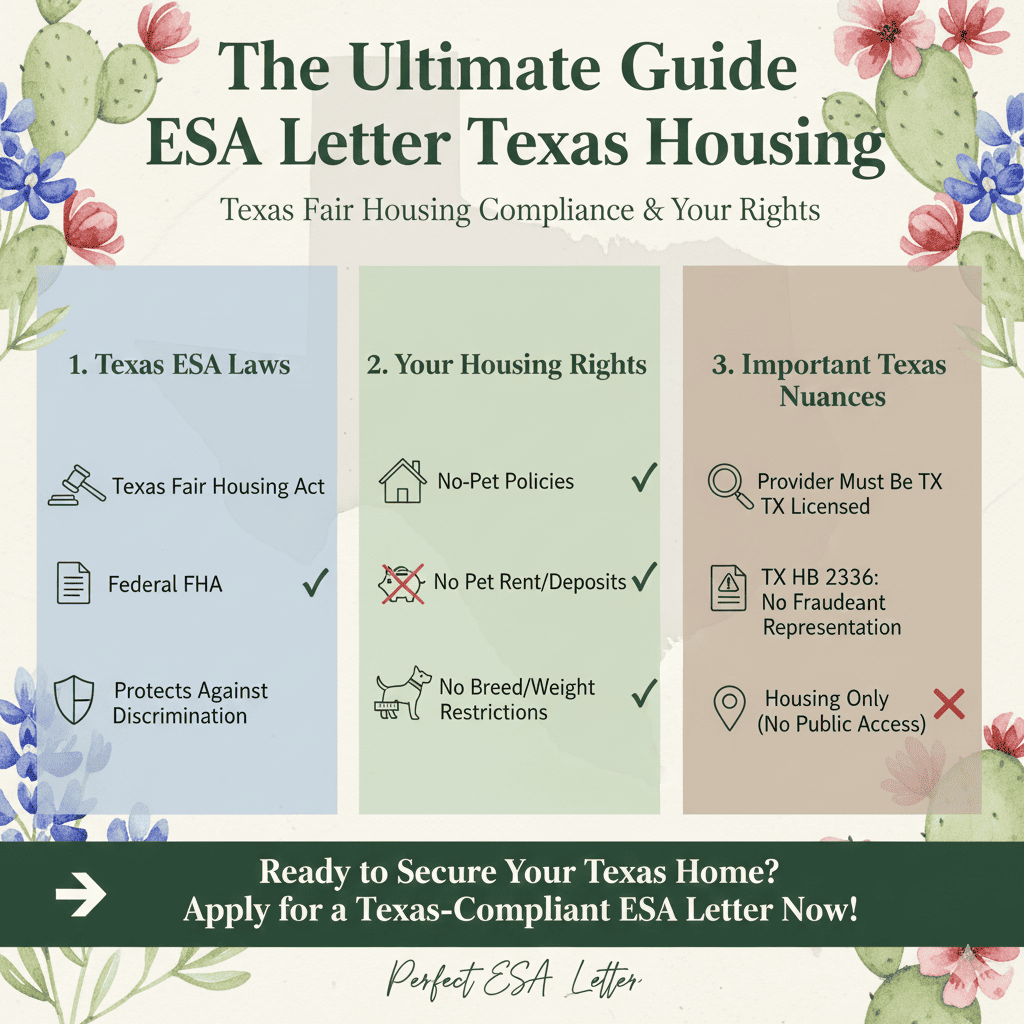
The legal framework for emotional support animals in Texas is built on two primary pillars: the Federal Fair Housing Act and the Texas Fair Housing Act (Texas Property Code Chapter 301). These laws work together to ensure that individuals with disabilities have an equal opportunity to use and enjoy their dwellings.
The Texas Fair Housing Act (TFHA)
The TFHA mirrors federal law, making it illegal for housing providers to discriminate against tenants based on disability. Under these regulations, a housing provider must allow an assistance animal if the tenant has a disability-related need for it.
What an ESA Letter Does for You in Texas:
-
Bypasses “No-Pet” Rules: Even if a building has a strict no-pet policy, they must accommodate your ESA.
-
Eliminates Pet Fees: Texas landlords cannot charge pet deposits, one-time pet fees, or monthly “pet rent” for a documented ESA.
-
Overrides Breed and Weight Restrictions: Property managers cannot deny your animal based on its breed (e.g., Pit Bulls or German Shepherds) or its size.
The Requirements for a Valid Texas ESA Letter
Not all letters are created equal. To be considered legitimate under ESA letter Texas housing standards, your documentation must meet specific criteria defined by HUD (the Department of Housing and Urban Development).
Essential Elements of a Legitimate Letter:
-
Licensed Professional: The letter must be written by a healthcare professional (therapist, psychiatrist, or doctor) who is licensed to practice in the state of Texas.
-
Current Documentation: Most landlords require the letter to be dated within the last 12 months.
-
Official Letterhead: The document must include the clinician’s contact information, license type, and license number.
-
The Nexus: The professional must confirm that you have a mental health-related disability and that the animal provides support that alleviates at least one symptom of that condition.
Warning: Texas HB 2336 and Fraudulent Representation
Texas has moved to protect the integrity of assistance animal laws. Under Texas law, it is a misdemeanor to intentionally misrepresent an animal as an assistance animal if it is not. This highlights the importance of working with a real clinician rather than using “instant” online registries or fake certificate websites.
ESA Housing Rights vs. Public Access in Texas
It is a common point of confusion for many Texas residents: where can you take your ESA? It is important to distinguish between “Housing Rights” and “Public Access.”
| Feature | Emotional Support Animal (ESA) | Service Animal (Dog/Mini Horse) |
| Legal Protection | Fair Housing Act (FHA) | Americans with Disabilities Act (ADA) |
| Housing Rights | Yes (No pet fees/No pet rules) | Yes |
| Public Access (Stores/Cafes) | No (At owner’s discretion) | Yes |
| Workplace Access | Case-by-case accommodation | Yes |
| Training Required | None | Specific task training required |
While your ESA letter for Texas housing protects you at home, it does not grant you the right to bring your animal into a H-E-B, a restaurant, or a movie theater. Only task-trained service animals have those broad protections under the ADA.
How to Present Your Letter to a Texas Landlord
Presenting your ESA letter for Texas housing should be a professional and straightforward process. Following these best practices can help prevent unnecessary friction:
-
Request in Writing: While verbal requests are technically legal, it is always best to submit your request via email or certified mail to create a paper trail.
-
Submit Early: Try to provide your documentation before you sign the lease or as soon as you receive a diagnosis.
-
Be Transparent but Private: You are required to show that you have a disability-related need, but you are not required to disclose your specific diagnosis or provide medical records.
-
The “Interactive Process”: If a landlord has questions, participate in a good-faith dialogue. They are allowed to verify that the letter is authentic but cannot “grill” you on your medical history.
Internal Linking & Texas Resources
ESA Letter Texas Housing FAQ
1. Can a Texas landlord deny my ESA if they have a “no pets” policy?
No. Under the Fair Housing Act and Texas Property Code, an ESA is not a pet. As long as you have a valid ESA letter for Texas housing, the landlord must provide a reasonable accommodation, except in very rare cases (such as if the animal poses a direct threat to safety or would cause substantial property damage).
2. Do I have to pay a pet deposit for an ESA in Texas?
No. You are exempt from all pet-related deposits and monthly pet rent. However, you are still financially responsible if your animal causes actual physical damage to the property.
3. Can my Texas landlord require me to use a specific form?
No. While some landlords provide their own “ESA Verification Form,” they cannot require your doctor to fill it out as a condition of approval. A standard, legitimate ESA letter on professional letterhead is sufficient under HUD guidelines.
4. Does my therapist have to be located in Texas?
Yes. For your ESA letter for Texas housing to be considered valid by most property managers, the professional who signs it must hold a valid license to practice in the state of Texas.
5. Are there any housing types in Texas exempt from ESA laws?
Yes. Exemptions typically include owner-occupied buildings with no more than four units and single-family homes sold or rented by the owner without a real estate agent.
6. Can a landlord ask for my animal’s training certificates?
No. ESAs do not require any specialized training. Unlike service dogs, their benefit comes from their presence and companionship. Any landlord asking for “training papers” for an ESA is likely misinformed about the law.
7. How do I know if an online ESA service is legit for Texas?
A legitimate service will always involve a consultation with a licensed professional. If a site offers “instant” letters or “registration” without a clinical evaluation, it is likely a scam that will be rejected by Texas landlords.
8. What if I have more than one ESA in my Texas apartment?
You can have multiple ESAs, but your documentation must justify the need for each one. Your clinician should explain how each animal provides a unique therapeutic benefit that the others do not.
Conclusion: Secure Your Texas Home Today
Navigating ESA letter Texas housing requirements is about understanding your rights and ensuring you have the professional documentation to back them up. In the Lone Star State, the law is on your side, provided you follow the clinical path to a legitimate letter.
By eliminating pet rent and deposits, you can save thousands of dollars over the life of a lease while ensuring you have the emotional support you need to thrive. Don’t let a “no-pets” sign keep you from the home you deserve.
Ready to protect your rights and your companion?
Connect with a Texas-licensed professional and get the documentation that landlords respect.