
The Complete Guide to Getting an ESA Letter in California: Rules, Rights, and Success
The Complete Guide to Getting an ESA Letter in California: Rules, Rights, and Success
California is known for its progressive stance on mental health and disability rights. For many residents, an emotional support animal (ESA) provides the companionship and therapeutic relief necessary to navigate conditions like anxiety, depression, and PTSD. However, California also has some of the most specific regulations in the country regarding how an ESA letter in California must be obtained.
If you are a tenant in the Golden State, simply having a pet isn’t enough to qualify for housing protections. To bypass “no-pet” policies and waive monthly pet rent, you must adhere to state-specific laws like Assembly Bill 468 (AB 468). Understanding these rules is the difference between a seamless move-in and a rejected housing application.
At Perfect ESA Letter, we specialize in California-compliant documentation. We understand the nuances of the 30-day clinical relationship rule and connect you with state-licensed professionals who follow every legal detail. To ensure your housing request is bulletproof, you can apply for an ESA letter now and begin your journey toward a supportive home.
Understanding AB 468: The “30-Day Rule” for an ESA Letter in California
One of the most important things to know about getting an ESA letter in California is the 30-day waiting period. Enacted to curb fraudulent “instant” letters, AB 468 requires a genuine clinical relationship between the patient and the healthcare provider.
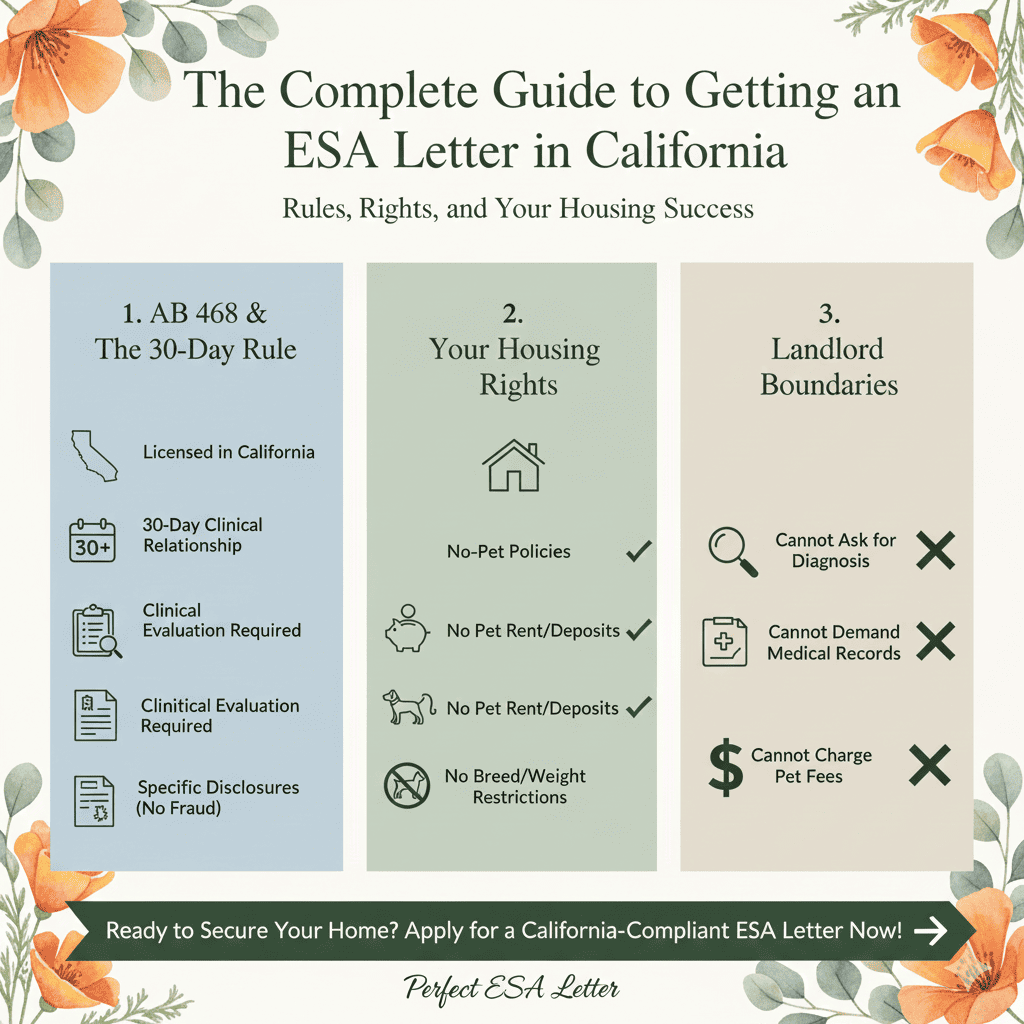
The Key Requirements of AB 468
For an ESA letter to be valid in California, the licensed healthcare practitioner must:
-
Be Licensed in California: The provider must be authorized to practice within the state’s jurisdiction.
-
Establish a 30-Day Relationship: The clinician must have an established therapeutic relationship with the client for at least 30 days before issuing the documentation.
-
Conduct a Clinical Evaluation: A thorough assessment of the individual’s need for an emotional support animal is mandatory.
-
Provide Specific Disclosures: The letter must include the provider’s license number, type, and a notice that misrepresenting a support animal as a service animal is a misdemeanor.
Important Note: If a website promises you an “instant” ESA letter for a California address, it is likely non-compliant with AB 468. Landlords are well-aware of this law and will check the dates to ensure the 30-day rule was followed.
Your Housing Rights in the Golden State
Once you have a valid ESA letter in California, you are protected by both federal law (the Fair Housing Act) and state law (the California Fair Employment and Housing Act, or FEHA). These laws provide several significant benefits:
1. Exemption from “No-Pet” Policies
Even if your lease explicitly forbids pets, a landlord must make a “reasonable accommodation” for your ESA. Your animal is not legally considered a pet; it is a piece of medical equipment, much like a wheelchair or an oxygen tank.
2. No Pet Rent or Deposits
California landlords are prohibited from charging pet-related fees for ESAs. This includes:
-
Initial pet deposits.
-
Monthly pet rent.
-
One-time “pet application” fees.
3. No Breed or Weight Restrictions
While a landlord might have a policy against large dogs or certain breeds (like Pit Bulls or Rottweilers), these restrictions generally do not apply to ESAs. The animal must be evaluated on its own behavior, not its breed or size.
Summary of California ESA Rights
| Protection Feature | Standard Pet | ESA with Valid CA Letter |
| Housing Access | Landlord’s Discretion | Mandatory (with few exceptions) |
| Monthly Pet Rent | Allowed | Prohibited |
| Security Deposits | Extra Fees Allowed | Prohibited |
| Breed/Size Limits | Allowed | Waived |
| 30-Day Wait Period | N/A | Required for New Letters |
How to Talk to Your California Landlord
Presenting your ESA letter in California can feel intimidating, but remember that you are exercising a legal right. Here are best practices for the conversation:
-
Be Proactive: While you can request an accommodation at any time, it is best to do so before you sign the lease or as soon as you receive your letter.
-
Provide the Letter, Nothing More: You do not need to share your medical history, your specific diagnosis, or your therapy notes. The letter itself is the only proof required.
-
Keep a Digital Trail: Always send your request via email or certified mail so you have proof of the date and time you submitted your documentation.
Internal Linking & Strategic Resources
Frequently Asked Questions (FAQs)
Can I get an ESA letter in California for a cat?
Yes. While AB 468 specifically mentions “emotional support dogs” in its wording regarding fraudulent sales, the Fair Housing Act and FEHA protect all common household animals used for emotional support, including cats, birds, and rabbits.
Does my ESA letter from another state work in California?
Generally, landlords in California will insist on a letter from a provider licensed in California. If you move from another state, it is a best practice to establish a relationship with a local clinician to ensure your documentation meets California’s strict AB 468 standards.
What happens if a landlord refuses my ESA?
If you have a valid ESA letter in California and your landlord refuses to accommodate you, they may be in violation of the Fair Employment and Housing Act. You can file a complaint with the California Civil Rights Department (CRD) or HUD.
Do I need to register my ESA in a California database?
No. There is no state-sanctioned or legally required “registry” for ESAs. Any website asking you to pay for “registration” or “certification” is a scam. The only legal document is your clinician’s letter.
Can my landlord ask for my medical records?
No. Under California law, a housing provider may ask for documentation confirming your disability-related need for the animal, but they cannot ask for your specific diagnosis, treatment history, or access to your medical records.
Does a 30-day relationship mean I need 30 therapy sessions?
No. AB 468 requires a 30-day relationship, not a specific number of sessions. This timeline ensures the provider has had adequate time to assess your condition and the therapeutic benefit the animal provides.
Can I bring my ESA to a restaurant in California?
No. Unlike service animals, ESAs do not have public access rights in California. They are protected in housing and occasionally in workplaces, but private businesses like restaurants and grocery stores can legally deny them entry.
Are there any housing types exempt from ESA laws?
Yes. Certain owner-occupied buildings with four or fewer units and single-family homes sold or rented without a broker may be exempt from the Fair Housing Act. However, California’s FEHA often provides broader protections that may still apply.
Conclusion: Start Your 30-Day Relationship Today
Obtaining an ESA letter in California requires patience and adherence to state law, but the reward is long-term housing security and financial savings. By following the AB 468 guidelines and working with a licensed professional, you can ensure that you and your animal are protected from discrimination.
Don’t wait until the last minute or rely on “instant” letters that won’t pass a landlord’s inspection. The 30-day clock starts as soon as you begin your clinical relationship.
Ready to secure your rights in California?
Connect with a licensed professional who understands the Golden State’s laws and start your evaluation today.