
How to Prove Your ESA is Legit: A Comprehensive Guide to Valid Housing Documentation
How to Prove Your ESA is Legit: A Comprehensive Guide to Valid Housing Documentation
For millions of people, an emotional support animal (ESA) provides the critical comfort and stability needed to manage mental health conditions like anxiety, depression, or PTSD. However, as the popularity of ESAs has grown, so has the skepticism of landlords and property managers. If you’ve ever felt anxious about presenting your animal’s paperwork, you aren’t alone. Learning how to prove your ESA is legit is essential to ensuring you can live peacefully with your companion without the burden of extra fees or “no-pet” restrictions.
The Fair Housing Act (FHA) is a powerful federal law that protects your right to live with an assistance animal. But these protections aren’t automatic; they require specific, verifiable documentation. In a world of “instant” online certificates and fake registries, knowing the difference between a legal document and a worthless piece of paper is the key to housing security.
At Perfect ESA Letter, we specialize in connecting individuals with state-licensed mental health professionals who provide legally binding documentation. If you want to skip the confusion and get it right the first time, apply for an ESA letter now to schedule your professional consultation.
The Only Way to Prove an ESA is Legit: The ESA Letter
The most common misconception is that you need a “certificate,” a “vest,” or a “registration number” to prove your animal is an ESA. This is false.
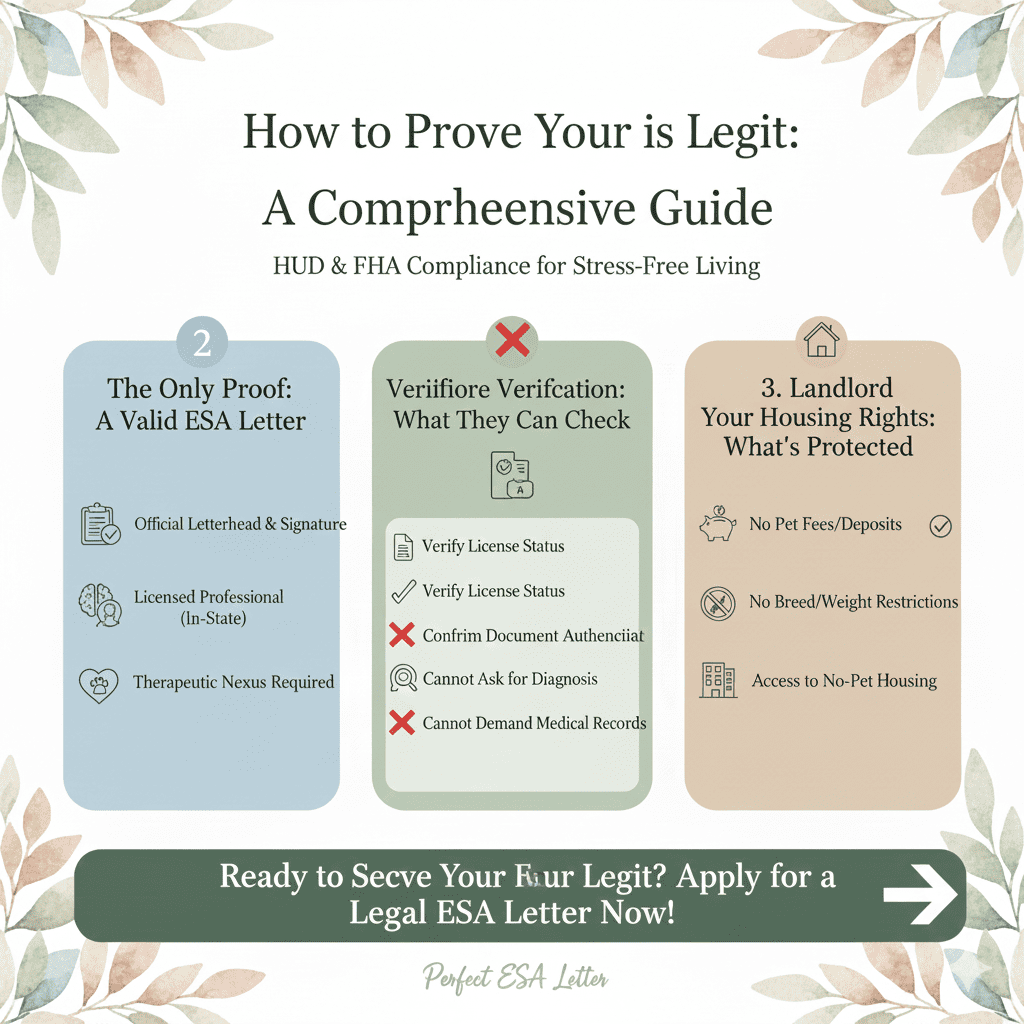
Under Department of Housing and Urban Development (HUD) guidelines, the only valid way to prove your ESA is legit is by providing a signed ESA Letter from a licensed healthcare professional.
What Makes a Letter Legally Valid?
For your letter to hold up under the scrutiny of a landlord or a court, it must contain these specific elements:
-
Official Letterhead: The document must be on the professional’s business stationery.
-
Licensing Information: It must include the provider’s license type (e.g., LCSW, LMFT, Psychologist), license number, and the state of issuance.
-
Provider Contact Info: A landlord must be able to verify the document by reaching out to the provider’s office.
-
The “Therapeutic Nexus”: The letter must state that you have a mental or emotional disability and that the animal provides support that alleviates at least one symptom of that disability.
-
Active Signature: The letter must be signed and dated by the provider.
How Landlords Verify Your ESA Documentation
When you ask how to prove your ESA is legit, you are essentially asking how to satisfy your landlord’s legal right to verification. According to FHA rules, landlords can—and often do—check the following:
1. License Verification
Landlords often use state licensing boards to look up your provider’s license number. If the professional is not licensed in your state of residence, the landlord may have grounds to deny the request.
2. Authenticity Confirmation
A landlord may contact the professional’s office to ask: “Did you write this letter for this person?” They cannot, however, ask for your medical records, your specific diagnosis, or the severity of your condition.
3. Telehealth Compliance
HUD explicitly allows for telehealth providers. However, the provider must have “personal knowledge” of the individual. This is why services that provide “instant” letters without a consultation are often flagged as illegitimate.
Common Red Flags: How to Spot an Illegitimate ESA Service
If you want to know how to prove your ESA is legit, you must also know how to spot a scam. Using a fraudulent service doesn’t just waste your money—it can lead to eviction or legal trouble.
| Feature | Legitimate Service (e.g., Perfect ESA Letter) | Fake “Registry” / Scam Site |
| Consultation | Requires a live or clinical evaluation. | Guaranteed approval in minutes. |
| Documentation | A signed letter from a licensed pro. | Certificates, ID cards, and “lifetime” registration. |
| Provider Info | Verifiable license number provided. | No specific provider mentioned. |
| Pricing | Transparent, covering clinical time. | Suspiciously low “entry fees.” |
| Legality | Follows FHA & HUD guidelines. | Claims “ADA protection” (ESAs don’t have ADA rights). |
Steps to Prove Your ESA is Legit to Your Landlord
Follow this protocol to ensure your reasonable accommodation request is handled professionally:
-
Get Your Professional Evaluation: Use a trusted platform like Perfect ESA Letter to meet with a clinician licensed in your state.
-
Submit a Formal Request: Provide your landlord with a copy of your letter and a brief written request for a “reasonable accommodation.”
-
Keep Records: Save copies of all correspondence. If your landlord asks for extra “certificates” or “registration,” politely inform them that HUD guidelines do not require these and that your letter is the sufficient legal proof.
-
Renewal: It is a best practice to refresh your letter annually. While the law is vague on expiration, a “current” letter (within the last 12 months) is much harder for a landlord to challenge.
Internal Linking & Compliance Tools
Frequently Asked Questions (FAQs)
1. Can a landlord require my animal to wear a vest to prove it’s legit?
No. HUD guidelines state that an animal does not need any identifying gear like a vest or tag to be considered an ESA. Your legal letter is the only proof required.
2. Is a “registration number” helpful in proving my ESA is legit?
No. National ESA registries are private databases with no legal authority. Landlords are increasingly trained to view “registration numbers” as a red flag for a scam.
3. Can I use a letter from my regular family doctor?
Yes. Any licensed healthcare professional with personal knowledge of your health can write an ESA letter. However, many primary care doctors are unfamiliar with the specific HUD language required, which is why many people prefer to use specialized mental health services.
4. How do I prove my ESA is legit if I have more than one?
If you have multiple ESAs, your clinician must write a letter (or letters) explaining the specific therapeutic benefit each animal provides. You cannot simply use one animal’s letter to cover a second animal.
5. Can a landlord call my therapist to ask about my diagnosis?
No. Privacy laws (HIPAA) and HUD rules prevent landlords from inquiring about the specifics of your disability. They can only confirm the authenticity of the letter and that the provider is indeed treating you.
6. What if my landlord insists on me using their own “special form”?
According to HUD, a landlord cannot require a healthcare professional to use a specific form or provide a notarized statement. If your letter contains all the necessary legal elements, it is sufficient.
7. Does my ESA have to be a dog or cat to be legit?
No. While dogs and cats are the most common, HUD recognizes “small, domesticated animals traditionally kept in the home” as potential ESAs, including birds, rabbits, hamsters, and even certain reptiles.
Conclusion: Don’t Leave Your Housing to Chance
Knowing how to prove your ESA is legit is about having the right tools and the right documentation. In an era where housing providers are more vigilant than ever, showing up with a verified, clinician-backed letter is the only way to protect your rights and your companion.
At Perfect ESA Letter, we take the guesswork out of the process. We ensure your letter is signed by a professional licensed in your state and meets all federal standards, giving you the peace of mind you deserve.
Ready to get the proof you need?
Protect your home and stay together with your animal. Our streamlined process connects you with the experts who can help.