
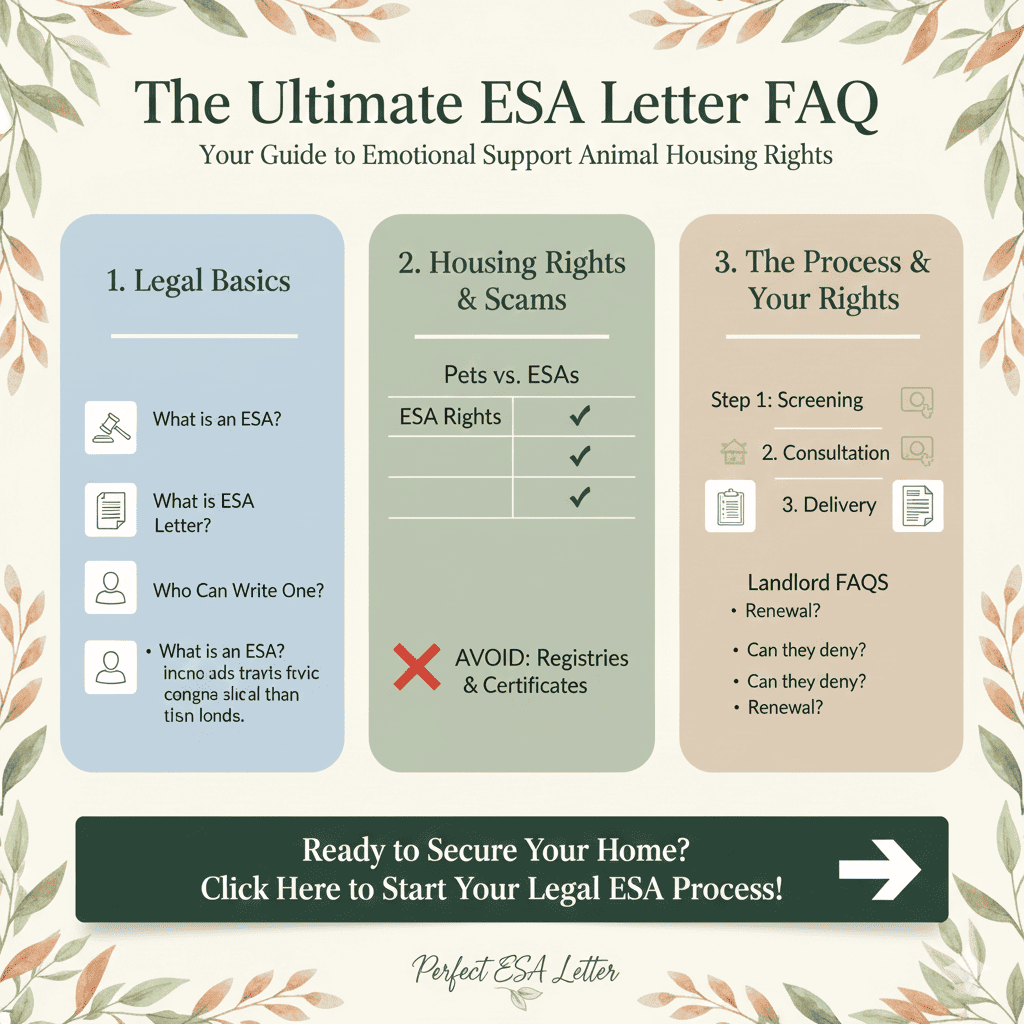
The Ultimate ESA Letter FAQ: Your Guide to Emotional Support Animal Housing Rights
The Ultimate ESA Letter FAQ: Your Guide to Emotional Support Animal Housing Rights
Navigating the world of emotional support animals (ESAs) often feels like a maze of legal jargon, landlord demands, and confusing online claims. Whether you are dealing with a strict “no-pets” policy or trying to avoid expensive monthly pet fees, having the right information is your best defense. This ESA letter FAQ is designed to provide clear, professional answers to the questions that matter most to tenants and pet owners.
Under the Fair Housing Act (FHA), an emotional support animal is not a pet; it is a vital part of a person’s mental health treatment plan. To secure these rights, you need a valid recommendation from a licensed professional.
At Perfect ESA Letter, we specialize in making this process transparent and legally compliant. If you need a document that landlords must legally respect, apply for an ESA letter now to begin your official consultation.
The Core ESA Letter FAQ: Understanding the Basics
What is an Emotional Support Animal (ESA)?
An ESA is a companion animal that provides therapeutic benefit to an individual with a mental or emotional disability. Unlike service animals, ESAs do not require specialized training to perform specific tasks. Their mere presence helps alleviate symptoms of conditions like anxiety, depression, and PTSD.
What is an ESA Letter?
An ESA letter is the only legal document recognized by the Department of Housing and Urban Development (HUD) and the Fair Housing Act. It is a signed recommendation from a licensed healthcare professional stating that you have a disability-related need for your animal.
Who Can Legally Write an ESA Letter?
The “Who” is the most important part of ESA letter FAQ compliance. Only a licensed healthcare professional can sign your letter. This includes:
-
Licensed Mental Health Professionals (LMHPs): Counselors, Social Workers (LCSW), and Marriage & Family Therapists (LMFT).
-
Psychiatrists and Psychologists.
-
Primary Care Physicians and Nurse Practitioners.
Legality and Housing: What Every Tenant Should Know
The Fair Housing Act provides strong protections for ESA owners, but these rights only apply if you have a legitimate letter.
Can a Landlord Reject My ESA?
Generally, no. If you provide a valid letter, a landlord must grant a “reasonable accommodation.” However, there are limited exceptions where a landlord can deny a request:
-
The animal poses a direct threat to the safety of others.
-
The animal causes substantial physical damage to the property.
-
The accommodation creates an undue financial burden on the landlord.
-
The housing is an owner-occupied building with four or fewer units (the “Mrs. Murphy” exemption).
Table: Pets vs. Emotional Support Animals
| Feature | Standard Pet | Emotional Support Animal (ESA) |
| Housing Rights | Subject to lease rules | Protected by Fair Housing Act |
| Pet Rent/Fees | Yes, usually required | No, legally exempt |
| No-Pet Policies | Must follow policies | Allowed as a “Reasonable Accommodation” |
| Training Required | No | No |
| Documentation | None | Valid ESA Letter from Licensed Pro |
Avoiding Scams: The “Registry” Trap
A common entry in any ESA letter FAQ involves online registries. You may see websites offering “official registration,” “certificates,” or “IDs” for your pet.
The Truth: There is no such thing as an “official” ESA registry. HUD specifically states that certificates and ID cards from the internet do not, by themselves, establish a disability-related need. A landlord is well within their rights to reject these documents. A legitimate letter must come from a clinician who has evaluated you.
How the Evaluation Process Works
Getting a legal letter through a telehealth service is a straightforward, three-step process:
-
The Screening: You complete a questionnaire regarding your mental health history and current symptoms.
-
The Consultation: You meet with a state-licensed professional (via video or phone) to discuss how an animal helps manage your condition.
-
The Delivery: If approved, you receive a signed, verifiable letter on the clinician’s official letterhead.
Internal Linking & Compliance Resources
Detailed ESA Letter FAQ (People Also Ask)
1. Do I need to tell my landlord I have an ESA before I sign the lease?
While honesty is often the best policy, you are not legally required to disclose your ESA during the application process. You can request a reasonable accommodation at any time—before moving in or after you have already occupied the unit.
2. Can my landlord charge a pet deposit for my ESA?
No. Because ESAs are not considered pets under the law, they are exempt from pet deposits, non-refundable pet fees, and monthly pet rent. However, you are still financially responsible for any actual damage the animal causes to the apartment.
3. Does my ESA letter need to be renewed?
Yes. Most landlords and HUD guidelines recommend that an ESA letter be updated annually. This ensures that the clinical relationship is current and that the animal remains a necessary part of your ongoing treatment.
4. Can a landlord enforce breed or weight restrictions on an ESA?
No. Under the FHA, breed, size, and weight restrictions that apply to pets do not apply to assistance animals. A landlord cannot deny a Golden Retriever just because they have a “dogs under 20 lbs” rule.
5. Can I have more than one ESA?
Yes, but your documentation must justify the need for each animal. Your provider must explain how each animal provides a distinct therapeutic benefit that the other does not.
6. Does my ESA have public access rights like a service dog?
No. This is a common point of confusion in our ESA letter FAQ. ESAs are protected in housing (FHA), but they do not have the right to enter restaurants, grocery stores, or malls under the ADA.
7. What if my landlord asks for my medical records?
A landlord cannot ask for your medical records, a detailed diagnosis, or a medical examination. They are only entitled to a letter confirming that you have a disability and a related need for the animal.
8. Is a “vest” or “ID tag” required for my ESA?
No. These items are purely decorative. While they might make it clear to neighbors that your animal is working, they hold no legal weight. The only “ID” that matters is your signed letter.
Conclusion: Protect Your Rights with a Verified Letter
We hope this ESA letter FAQ has cleared up the most common misconceptions about emotional support animals. The legal protections offered by the Fair Housing Act are powerful, but they rely entirely on having authentic, clinician-backed documentation.
Don’t let a “no-pet” policy separate you from the animal that helps you heal. Secure your housing, eliminate unnecessary fees, and get the peace of mind you deserve.
Ready to get your legal housing protection?
Our network of state-licensed professionals is ready to evaluate your needs and provide the documentation you need to live comfortably with your companion.