
The Comprehensive Guide to ESA Letter Requirements: HUD and FHA Compliance
The Comprehensive Guide to ESA Letter Requirements: HUD and FHA Compliance
The landscape of emotional support animal (ESA) laws has shifted significantly as we enter 2026. While the core federal protections of the Fair Housing Act (FHA) remain strong, the specific ESA letter requirements that property managers and online screening portals (like PetScreening.com) look for have become much more stringent.
Gone are the days when a generic “certificate” from a registry website would suffice. In 2026, a valid ESA letter is a legal document that must follow strict clinical and state-specific protocols to ensure your housing accommodation is granted. If your documentation is missing even one required element, your landlord may have legal grounds to deny your request, potentially costing you thousands in pet fees and deposits.
At Perfect ESA Letter, we specialize in ensuring every document we facilitate meets or exceeds current federal standards. If you’re ready to secure a legally compliant document, you can apply for an ESA letter now and begin your evaluation with a state-licensed professional.
The Core ESA Letter Requirements for 2026
For a document to be legally recognized under the Fair Housing Act, it must be more than just a “doctor’s note.” HUD guidelines have clarified that the letter must be an official medical recommendation based on an individualized assessment.
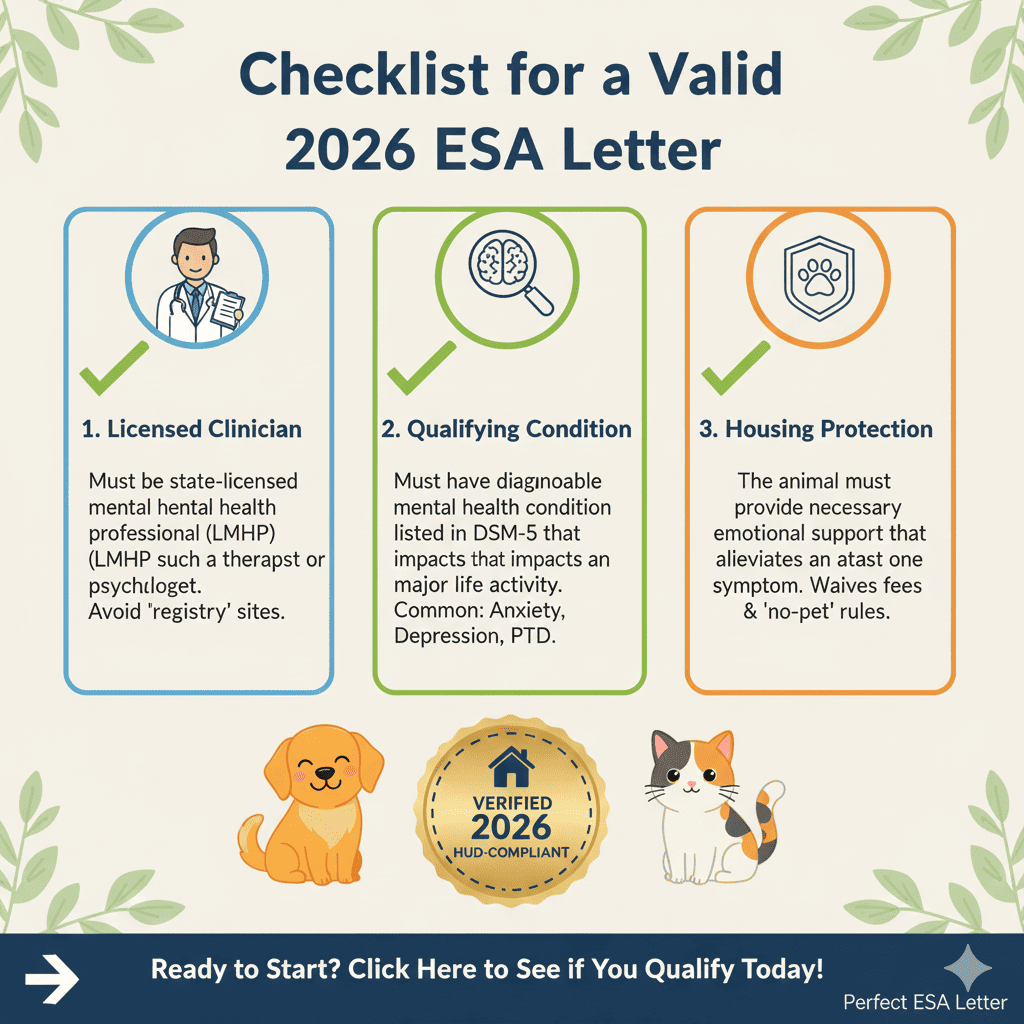
1. Professional Clinician Credentials
The most critical requirement is who signs the letter. In 2026, the document must be issued by a Licensed Mental Health Professional (LMHP) who is currently licensed in the state where you reside.
-
Required Info: The letter must display the provider’s full name, license type (e.g., LCSW, LMFT, Psychiatrist), license number, and the state of jurisdiction.
-
Verification: Landlords now routinely verify these numbers on state licensing board websites.
2. The Clinical “Nexus” Statement
A valid letter must establish a “therapeutic nexus.” This means it must clearly state:
-
That you have a mental or emotional impairment that substantially limits one or more major life activities (e.g., sleeping, social interaction, working).
-
That the animal is a necessary accommodation because it provides support that alleviates at least one specific symptom of that disability.
3. Live Clinical Evaluation
HUD has taken a hard stance against “instant” letters. One of the primary ESA letter requirements in 2026 is that the clinician must have “personal knowledge” of the patient. This necessitates a live interaction—either through a phone call or a video telehealth session—to conduct a proper evaluation.
2026 State-Specific Requirements: The 30-Day Rule
In addition to federal rules, several states have enacted laws to prevent fraudulent ESA claims. If you live in one of these states, your ESA letter requirements include an established 30-day relationship with your therapist.
States with 30-Day Relationship Mandates:
-
California (AB 468): Requires a 30-day therapeutic relationship and a live evaluation.
-
Arkansas (HB 1420): Mandates a 30-day relationship and specific disclosures.
-
Montana, Iowa, and Louisiana: Have similar 30-day established relationship requirements.
If you are moving to or living in one of these states, a “same-day” letter is no longer legally valid. At Perfect ESA Letter, we manage these timelines for you to ensure your documentation is fully compliant with local statutes. You can apply for an ESA letter now to start your 30-day compliance window.
Anatomy of a Legitimate ESA Letter
To help you distinguish between a scam and a legal document, here is a breakdown of what a 2026-compliant letter looks like:
| Component | Legitimate Requirement | Scam Red Flag |
| Letterhead | Official professional letterhead with contact info. | Plain text or generic “Certification” logo. |
| Provider License | Verifiable state license number & expiration. | No license info or “Lifetime Registration.” |
| Diagnosis | Confirms a disability exists (names not required). | Often misses the “major life activity” link. |
| Animal Info | Specifies animal type (e.g., Dog, Cat). | Claims to cover “any and all animals.” |
| Signature | Hand-signed or verified digital signature. | Typed name or low-resolution image of a stamp. |
What Landlords CANNOT Require
While you must meet certain ESA letter requirements, it is equally important to know where the landlord’s authority ends. Under the FHA, a housing provider cannot:
-
Request Medical Records: They cannot ask for your specific diagnosis or detailed treatment history.
-
Demand a Specific Form: Landlords cannot force your doctor to fill out their own internal “ESA form” if your letter already contains the required information.
-
Charge Fees: They cannot charge “pet rent,” pet deposits, or administrative “processing fees” for the ESA request.
-
Enforce Breed/Weight Limits: ESAs are exempt from standard building pet restrictions unless the specific animal is proven to be dangerous.
Internal Linking & Compliance Tools
-
Learn the difference between an ESA and a Psychiatric Service Dog.
-
Apply for an ESA letter now to protect your housing.
Frequently Asked Questions (FAQs)
What are the basic ESA letter requirements for housing?
The letter must be written by a licensed mental health professional, dated within the last 12 months, and include the clinician’s license information. It must state that you have a disability-related need for the animal.
Can a landlord verify my ESA letter?
Yes. Landlords are permitted to contact the clinician’s office to verify that the letter is authentic and that the clinician is licensed. They cannot, however, ask for details about your condition.
Do I need to register my ESA on a website?
No. There is no official government registry for ESAs. Registration sites are often scams and do not fulfill legal ESA letter requirements. The letter itself is the only document you need.
Does the letter expire?
While HUD does not set a hard expiration, most landlords require the letter to be renewed annually to ensure your mental health needs are current. We recommend renewing every 12 months.
What if I have more than one ESA?
If you need multiple animals for different support tasks, your letter must provide a specific “therapeutic nexus” for each animal. You can apply for an ESA letter now if you need an evaluation for multiple support animals.
Can my primary care physician (PCP) write the letter?
Yes, any healthcare professional with personal knowledge of your mental health can write the letter. However, letters from mental health specialists (LCSWs, psychologists) are often processed more smoothly by property managers.
Conclusion: Protect Your Rights with a Compliant Letter
Meeting the legal ESA letter requirements is the only way to ensure your emotional support animal is protected in your home. As housing providers become more vigilant in 2026, having a document that is signed by a state-licensed professional and follows all HUD guidelines is non-negotiable.
Don’t risk your housing security with “instant” scams or incomplete documentation. At Perfect ESA Letter, we provide the expertise, the licensed clinicians, and the legal framework you need to live with your companion in peace.
Ready to get your 100% legal ESA letter?